Can you imagine Gen Z influencers posting dozens, or even hundreds, of snaps in a single day to interact with their fans on social media?
This extreme frequency of interaction and communication is a key reflection of the current communication preferences of Gen Z: they are not focused on posting carefully edited, seemingly perfect content, but rather on capturing real moments, engaging in instant interactions, having equal dialogues, and expressing themselves sincerely.
Recently, Snapchat and Kantar jointly released the first-ever “Top 50 Chinese Global Brands Favored by Gen Z” list. Among the brands listed, 26 are consumer electronics brands, 9 are gaming brands, 7 are e-commerce brands, and 8 are new energy vehicle brands. Tencent Games, Xiaomi, and SHEIN stood out, ranking in the top three.
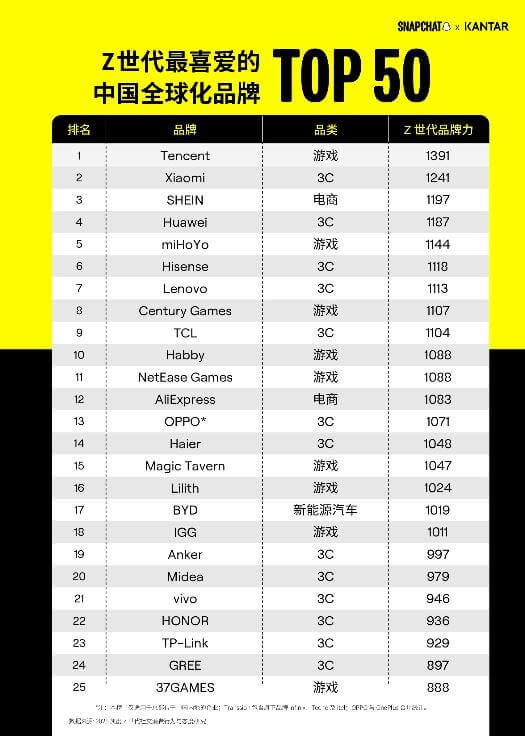
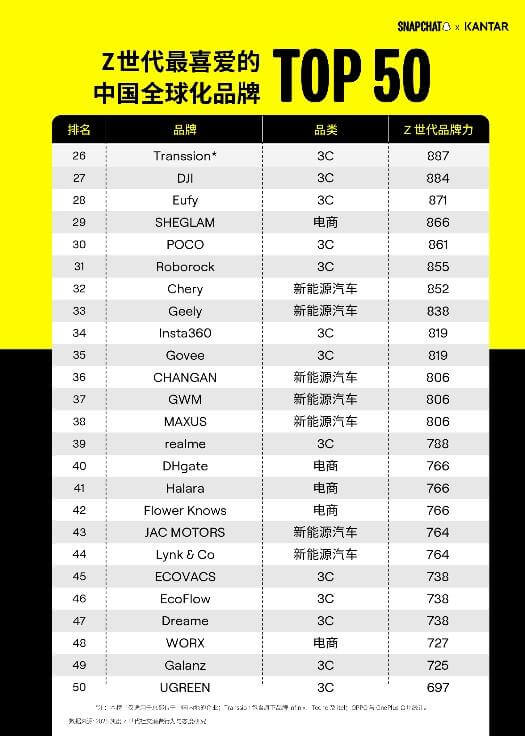
Gen Z’s TOP50 Chinese Global Brands
In the white paper “Globalization of Chinese Brands Through the Eyes of Gen Z,” which accompanies the list, the research also analyzes the characteristics of today’s Gen Z and the reasons why the listed brands have earned their trust. Representing roughly 25% of the global population, Gen Z accounts for an estimated market size of about $9.8 trillion, which is expected to grow to $12.6 trillion by 2030. No brand would want to miss out on such a massive market.
So, when it comes to winning over a Gen Z audience that everyone is vying for, what exactly are these Chinese global brands doing right?
Avoid grand narratives, nurture communities with sincerity.
“Digital natives,” “internet natives,” “interest-first,” “content-driven social interaction,” “highly personalized” … these labels together paint a portrait of Gen Z. According to Xie Wanling, Managing Director of Kantar Greater China’s Technology and Media Practice, the key to communicating with this generation is: “Choose the right platform, speak in Gen Z’s language, and communicate through the narrative styles they enjoy.”
Caryn Marjorie, a Gen Z creator from the U.S. with over two million followers on Snapchat, deeply resonates with this idea. She observes that Gen Z prefers natural, everyday, friend-like storytelling. This generation is indifferent to “big-budget, scripted content” and instead values content that is authentic, natural, and relatable—photos or videos don’t need to be perfect, but they must be captured and shared in a realistic, everyday setting.
Caryn Marjorie’s collaboration with a leading international Chinese smartphone brand exemplifies this approach. A few years ago, she was invited by the brand to visit its factories and offices in China, documenting the entire experience on Snapchat. “At that time, the U.S. market didn’t know much about this brand. Many of my followers told me it was through my posts that they first learned about it,” she recalled.
In fact, the brand did produce TVC-style advertisements for global markets, but for Gen Z, a candid behind-the-scenes Vlog telling the brand’s story was far more persuasive and trust-building than a polished, filtered brand video.
Why does this “de-polished” authentic content resonate more with Gen Z? The core reason lies in the natural differences in how users of different platforms and generations prefer to engage with brands. Zhang Xi, General Manager of Snapchat China, notes that on Snapchat, users’ primary need is building close relationships. “Snapchat was founded to help users connect authentically with their friends and family. Even today, 75% of users still use Snapchat mainly to communicate with their closest circles.”
This need for intimacy and connection extends to interactions with brands. Gen Z places high value on genuine engagement and connection with brands.
Liang Chen, Head of Marketing Science for Snapchat Asia-Pacific, adds that Snapchat’s core users are typical Gen Z users. “Snapchat has nearly 1 billion monthly active users globally, with 85% using the chat function daily. 77% of Snapchat users say they like to interact directly with brands on social media, compared with only 5% of non-Snapchat users. 74% of Snapchat users trust brands with a strong social media presence, versus 45% among non-Snapchat users.”
Liang Chen illustrates brand-user connection with a Snapchat example: U.S. fast-food chain Wendy’s ran multiple video ads promoting different meal combos, but the best-performing content on Snapchat turned out to be a single image reading: ‘saw this and thought of u’
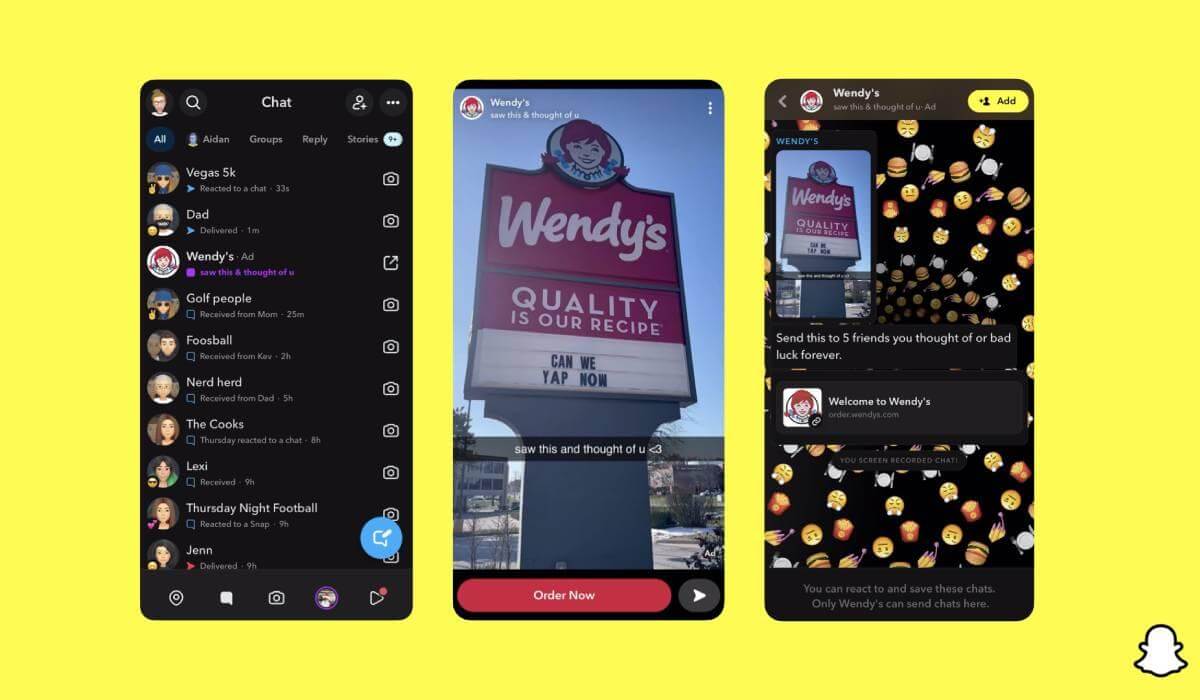
According to Liang Chen, what Gen Z craves most is emotional resonance and intimate connection. He emphasizes that when global brands communicate with them, the biggest pitfall to avoid is grandiose storytelling. Instead, brands should incorporate everyday expressions and deeply engage with communities.
“Gen Z values authenticity and genuine feelings. We recommend that brands communicate in ways that are close to the individual, enhance human-centric care, and truly enter their circles,” Liang Chen concluded.
Leverage local KOL’s to become the part of Gen Z.
Gen Z is not only the current driving force of consumption but also a key influencer in reshaping future consumer trends. Discussing some surprising findings from the report, Yang Rong, Digital Media Insights Director at Kantar, pointed out:
“People usually assume that Gen Z is more open to international brands, but our research shows otherwise. Gen Z differs sharply from Millennials (Gen Y): while Millennials are generally open to brands from any country, Gen Z tends to be more ‘selective.’ They favor local brands, yet they show an unusually high level of openness toward Chinese brands.”
Xie Wanling believes the core reason lies in the strong capabilities and high cost-performance of Chinese brands. “In the U.S., in Europe, and especially in the Middle East, Chinese brands perform very well in functionality, trendsetting, and innovation.”
This is particularly evident in the 3C (computer, communication, and consumer electronics) industry. All 26 3C brands on the list share the characteristic of high quality at an affordable price, while also attracting young consumers seeking technological novelty by building smart, interconnected ecosystems that offer them accessible and convenient experiences.
However, a strong product alone is only the first stepping stone to entering a market. Xie Wanling emphasizes that today, nearly 40–50% of consumers prioritize brand over product when making purchasing decisions. This has driven Chinese brands to shift from product-focused expansion to brand-focused strategies, with the proportion of brand advertising versus performance advertising increasing from the traditional “80/20” split to “70/30” or even “60/40.”
Yang Rong points out that from Millennials (Gen Y) to Gen Z, there is a trend from globalization toward localization. Unlike Gen Y, who favor “global, big brands, and grand narratives,” Gen Z is moving toward more localized and niche preferences.
A notable phenomenon is that Chinese brands, even at the very beginning of their expansion, are already considering how their products can fit into local usage scenarios and solve specific problems for local consumers.
Product localization is only the first step; localized communication is equally crucial. Liang Chen believes the most effective approach is to leverage the ecosystem of creators. He points out that creators in each region are deeply rooted in specific cultural communities, and their influence spreads across different audience segments. Choosing different creators can produce varying effects on a brand’s localization strategy.
“On Snapchat, creators interact with their followers more intimately and more frequently,” Liang Chen explains. When creators tell brand stories on Snapchat, the content is often more relatable and engaging. Compared with content created on other social media platforms, users on Snapchat show greater willingness to learn about products and make purchases.
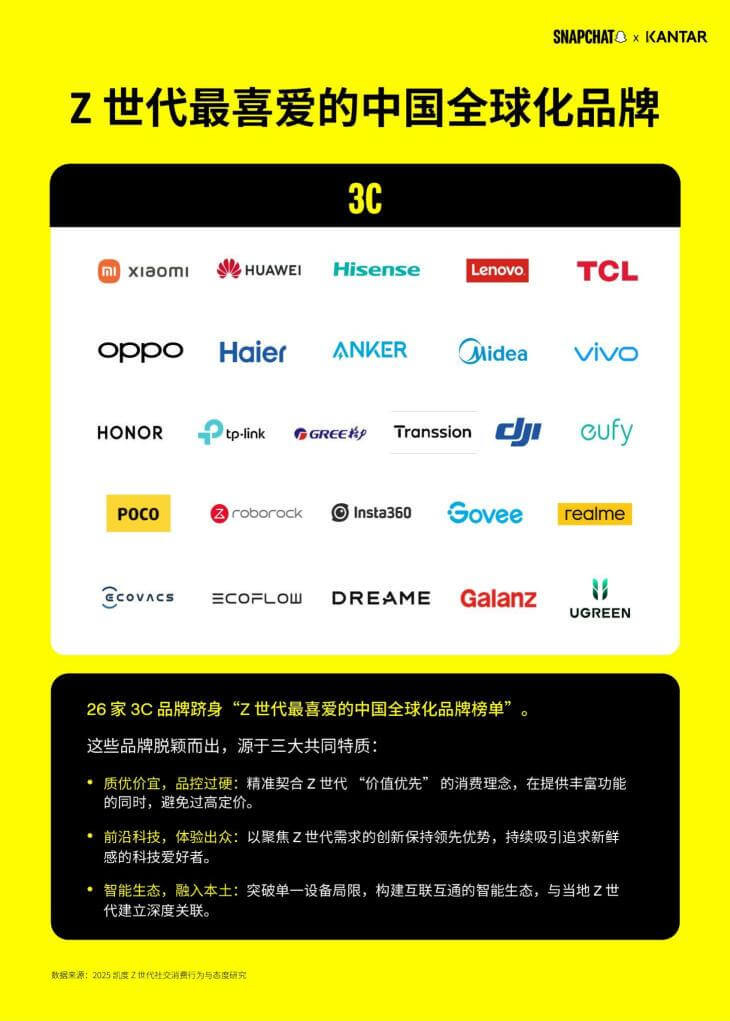
GenZ’s Favourite Chinese Global Brands
This is also reflected in Caryn Marjorie’s interactions with her fans. Through replying to private messages, answering questions, and other small daily interactions, she has built relationships with her followers that feel like friendships. Fans say that watching her travel Vlogs feels as if they are traveling alongside a close friend.
From a marketing perspective, leveraging different creators to engage with target consumers remains one of the most effective ways for global brands to quickly integrate into local cultures and meet local needs. For a generation like Gen Z, which highly values connection, creators are not just producers of niche content—they also serve as “trust hubs.” When brands use global creators to communicate and express themselves, they gain not only exposure but also a “ticket in” and a “seal of trust” within specific communities. This allows brands to become perceived as “one of them”, earning the trust and acceptance of Gen Z.
Embrace AR + AI and be Gen Z’s playful buddy.
Beyond leveraging creators to connect with Gen Z and have the creator ecosystem endorse the brand, Liang Chen sees another key factor in winning over Gen Z: using rapidly evolving technology to deliver unique brand experiences.
Take Tencent Games, which topped the Top 50 list, as an example. Its global promotion strategy goes beyond traditional performance advertising, adopting a “performance ads + community engagement + innovative interactions” approach. On Snapchat, Tencent Games actively experiments with AR marketing, launching multiple AR filters. Users can simply open their camera to “wear a game helmet” and immerse themselves in the gaming characters.
E-commerce platforms like SHEIN and AliExpress have introduced AR try-ons and virtual fitting rooms, gamifying the shopping experience. New energy vehicle brands such as BYD and Lynk & Co employ AR car exhibitions and AR esports events, transforming static displays into immersive explorations. Liang Chen notes that advertisers co-creating AR campaigns with Snapchat have already benefited, seeing improvements not only in conversion rates but also in social viral effects.
Gen Z is a highly experiential generation and among the fastest and most enthusiastic adopters of new technologies. Snapchat data shows that Gen Z are early adopters and avid users of AR and other emerging technologies, and they are willing to pay for AR experiences. Liang Chen points out that Snapchat’s long-term focus on AR has revealed a notable pattern: when users share AR filters, they often convey positive and uplifting emotions, which increases their willingness to participate, share, and discuss, creating powerful community-driven propagation.
Currently, Snapchat’s camera hosts over one million filters. On average, more than 350 million users engage with AR daily, generating over 8 billion AR filter uses per day. Liang Chen adds that AR filters allow users to express themselves in exaggerated, fun, rich, and highly personalized ways, enabling different interactions with friends and others even in the same scenario.
AIGC technology also opens up new possibilities for future brand-user interactions. From 3C products to new energy vehicles, from e-commerce to gaming, brands can combine AIGC and AR technologies to integrate products into communication scenarios that users enjoy. Liang Chen believes AIGC also provides opportunities for smaller teams and growing brands, allowing them to attempt localized strategies that previously only large companies could execute. In the future, whether brands can leverage AIGC to create fresher, personalized, and immersive experiences for Gen Z will become a crucial element of Chinese brands’ success.
From the era when Chinese brands went global needing to “de-China-ize,” to today confidently showcasing “Made in China” and “China Innovation,”global Gen Z’s perception of Chinese brands is undergoing a profound transformation. In their eyes, Chinese brands are increasingly seen as trendy, innovative, and trustworthy partners.
For brands expanding globally, Gen Z is not only a key audience to connect with today but also a long-term factor for brand growth, continuity, and future strategy.
When close connections, authentic expression, and immersive experiences together form the core standard by which Gen Z evaluates brands, we look forward to more Chinese brands engaging in fun, creative, and interactive ways, winning the genuine recognition of Gen Z in this global, two-way exchange.